Manchester group discovers 'radically different' physics in graphene superlattices

This is a press release for my recent paper of high-mobility Brown-Zak fermions

A group of researchers lead by Sir Andre Geim at The University of Manchester (UK) have discovered and characterised a new family of quasiparticles named Brown-Zak fermions in graphene-based materials. The team achieved this by aligning the atomic lattice of a graphene layer to that of an insulating boron nitride sheet, dramatically changing the properties of the graphene sheet.

The study follows years of successive advances in graphene-boron nitride superlattices which allowed the observation of a fractal pattern known as the Hofstadter’s butterfly. Today the researchers report another highly surprising behaviour of particles in such structures upon the application of high magnetic fields. “It is well known that in zero magnetic field electrons move in straight trajectories and if you apply a magnetic field they start to bend and move in circles”, say Julien Barrier, a PhD student who carried out the experimental work and lead author, “in graphene aligned with the Boron nitride, they also start to bend, but if you set the magnetic field at specific values electrons have a behaviour that corresponds to straight line trajectories, as if there is no magnetic field anymore!”. “Such a behaviour is radically different from textbook physics” adds Dr Piranavan Kumaravadivel, who fabricated the graphene devices. “We attribute this fascinating behaviour to the formation of novel quasiparticles at high magnetic fields” says Dr Alexey Berdyugin who contributed to the discussion over the results, “Those quasiparticles have their own unique properties and exceptionnally high mobility despite the extremely high magnetic field”. As published in Nature Communications on 13th November 2020 (doi: 10.1038/s41467-020-19604-0), the work describes how electrons behave in an ultra-high-quality superlattice of graphene with a revised framework for the fractal features of the Hofstadter’s butterfly. Fundamental improvements in graphene devices fabrication and measurement technques in the past decade have made this work possible.

A new quasiparticle

“The concept of quasiparticles is arguably one of the most important in condensed matter physics and quantum many-body systems. It was introduced by the theoretical physicist Lev Landau in the 1940s to depict collective effects as a one-particle excitation” explains Julien Barrier “They are used in a number of complex systems to account for many-body effects.”

Until now, the behaviour of collective electrons in graphene superlattices were thought in terms of the Dirac fermion, a quasiparticle that has unique properties resembling photons (particles with no mass), that replicate at high magnetic fields. However, this did not account for some experimental features, like the additional degeneracy of the states, nor did it match the finite mass of the quasiparticle in this state. The authors propose Brown-Zak fermions to be the family of quasiparticles existing in superlattices under high magnetic field. This is characterised by a new quantum number that can directly be measured. Interestingly, working at lower temperatures allowed them to lift the degeneracy with exchange interactions at ultra-low temperatures.

“Under the presence of a magnetic field, electrons in graphene start rotating with quantised orbits. For Brown-Zak fermions, we managed to restore a straight trajectory of tens of micrometres under high magnetic fields up to 16T (500,00 times earth’s magnetic field). Under specific conditions, the ballistic quasiparticles feel no effective magnetic field.” explain Dr Kumaravadivel and Dr Berdyugin.

High mobility of Brown-Zak fermions

In an electronic system, the mobility is defined as the capacity for a particle to travel upon the application of an electrical current. High mobilities have long been the holy grail when fabricating 2D systems such as graphene, as such materials would present additional properties (integer and fractional quantum hall effects), and potentially allow for the creation of ultra-high frequency transistors, the components at the heart of a computer processor. “For this study we prepared graphene devices that are extra-large with a very high level of purity”. says Dr Kumaravadivel. This allowed us to achieve mobilities of several millions of cm²/Vs, which means particles would travel straight across the entire device without scattering. Importantly, this was not only the case for classical Dirac fermions in graphene, but also realised for the Brown-Zak fermions reported in the work.

These Brown-Zak fermions define new metallic states, that are generic to any superlattice system, not just graphene and offers a playground for new condensed matter physics problems in other 2D material based superlattices.

Julien Barrier added “The findings are important, of course for fundamental studies in electron transport, but we believe that understanding quasiparticles in novel super- lattice devices under high magnetic fields can lead to the development of new electronic devices.” The high mobility means that a transistor made out of such a device could operate at higher frequencies, allowing a processor made out of this material to perform more calculations per unit of time, resulting in a faster computer. Applying a magnetic field would usually scale down the mobility and make such a device unusable for certain applications. The high mobilities of Brown-Zak fermions at high magnetic fields open a new perspective for electronic devices operating under extreme conditions.

High resolution illustrations

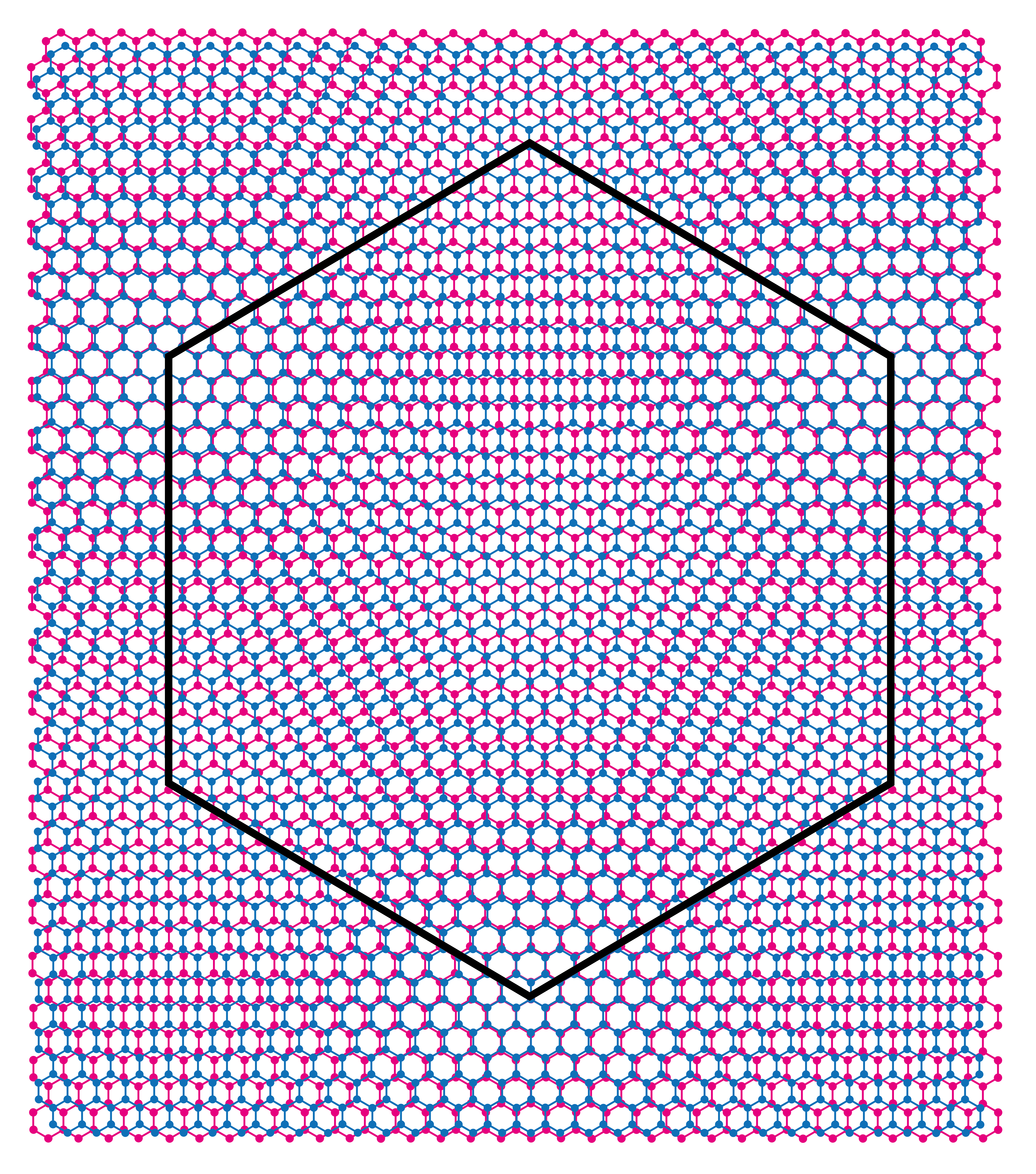
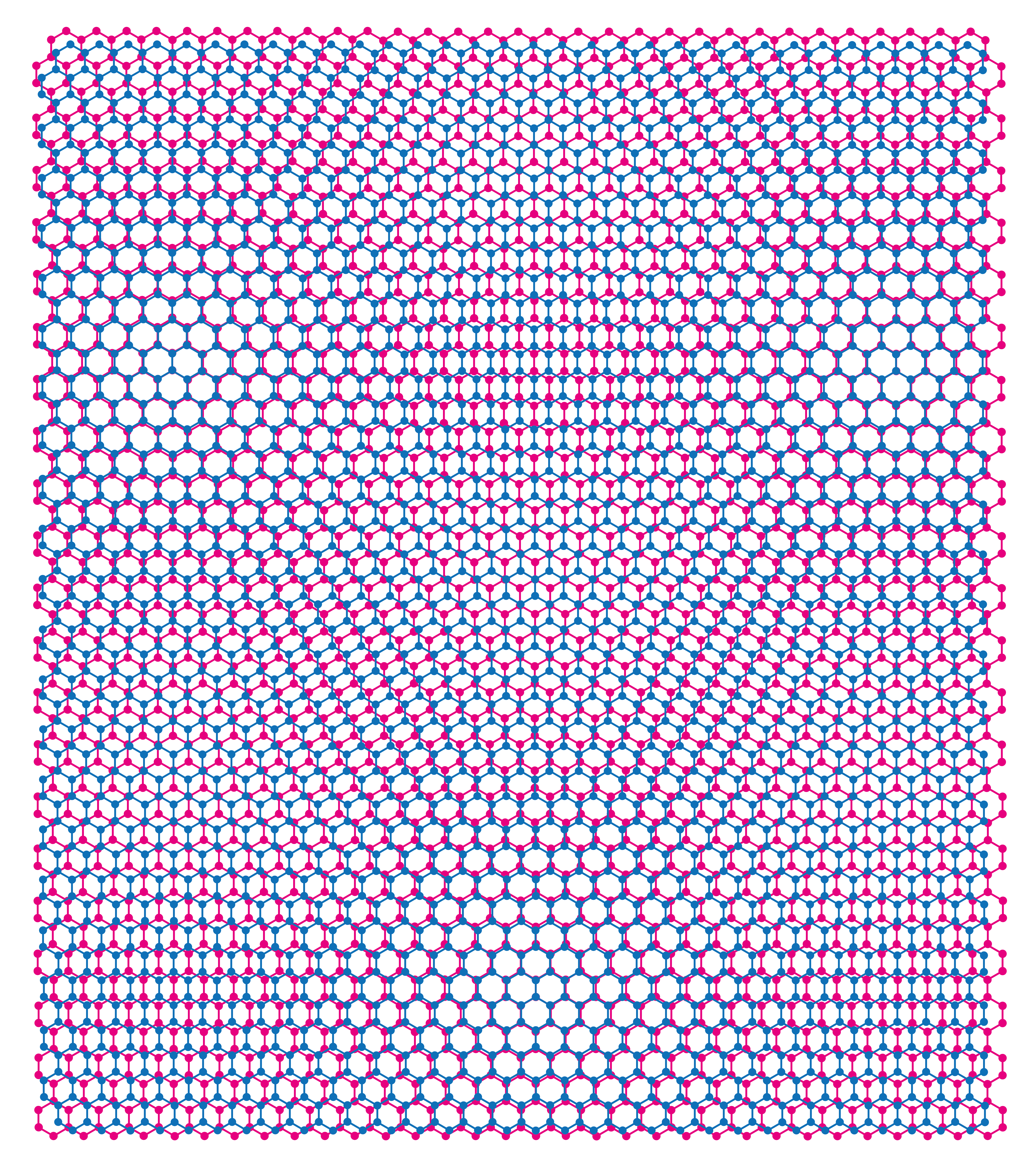
Graphene and boron nitride (hBN) both present a hexagonal structure. hBN is 1.8% larger, so stacking the two will create a Moiré superlattice, with a size constant hundreds of times larger.

graphene - hBN superlattice
superlattice-02

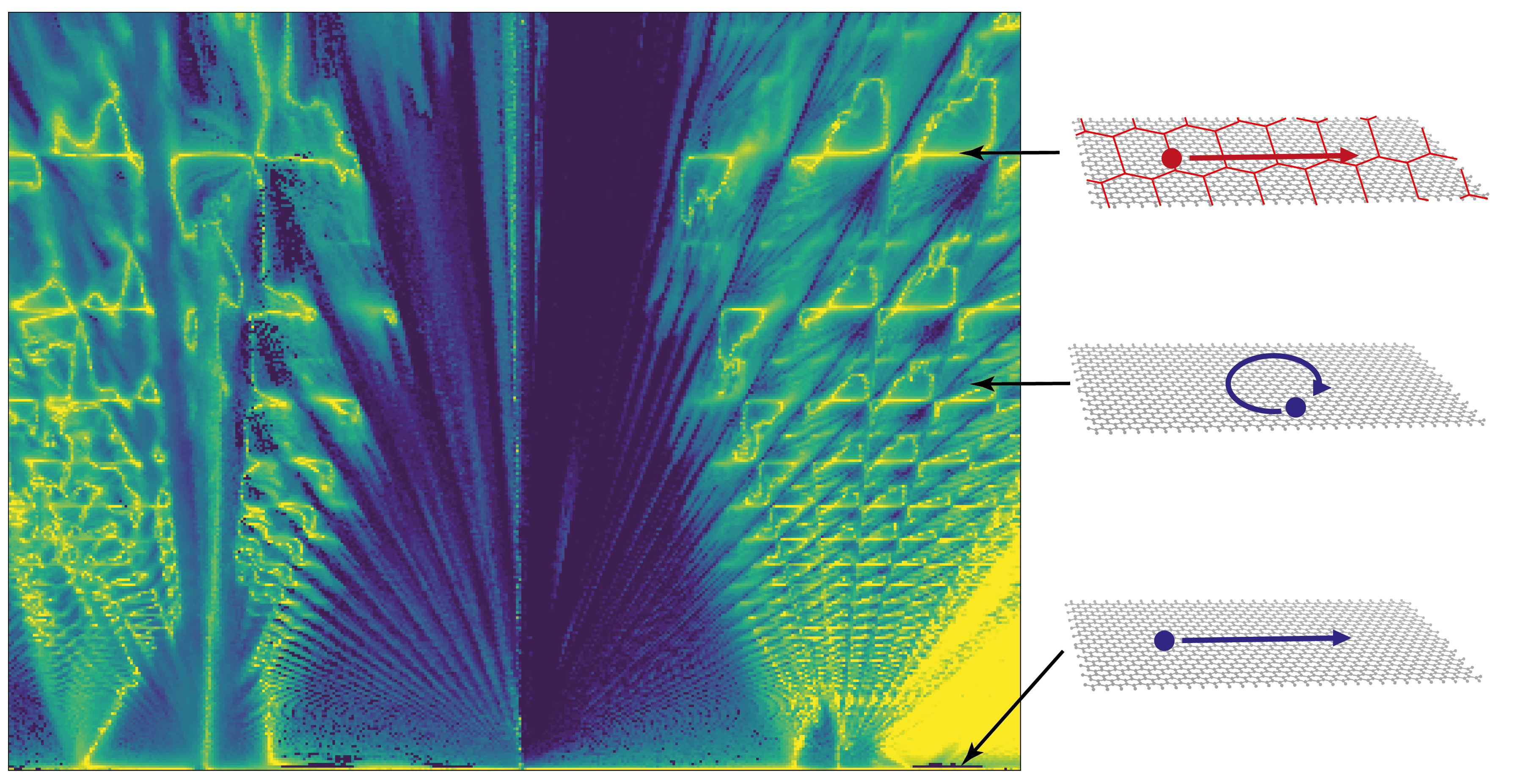
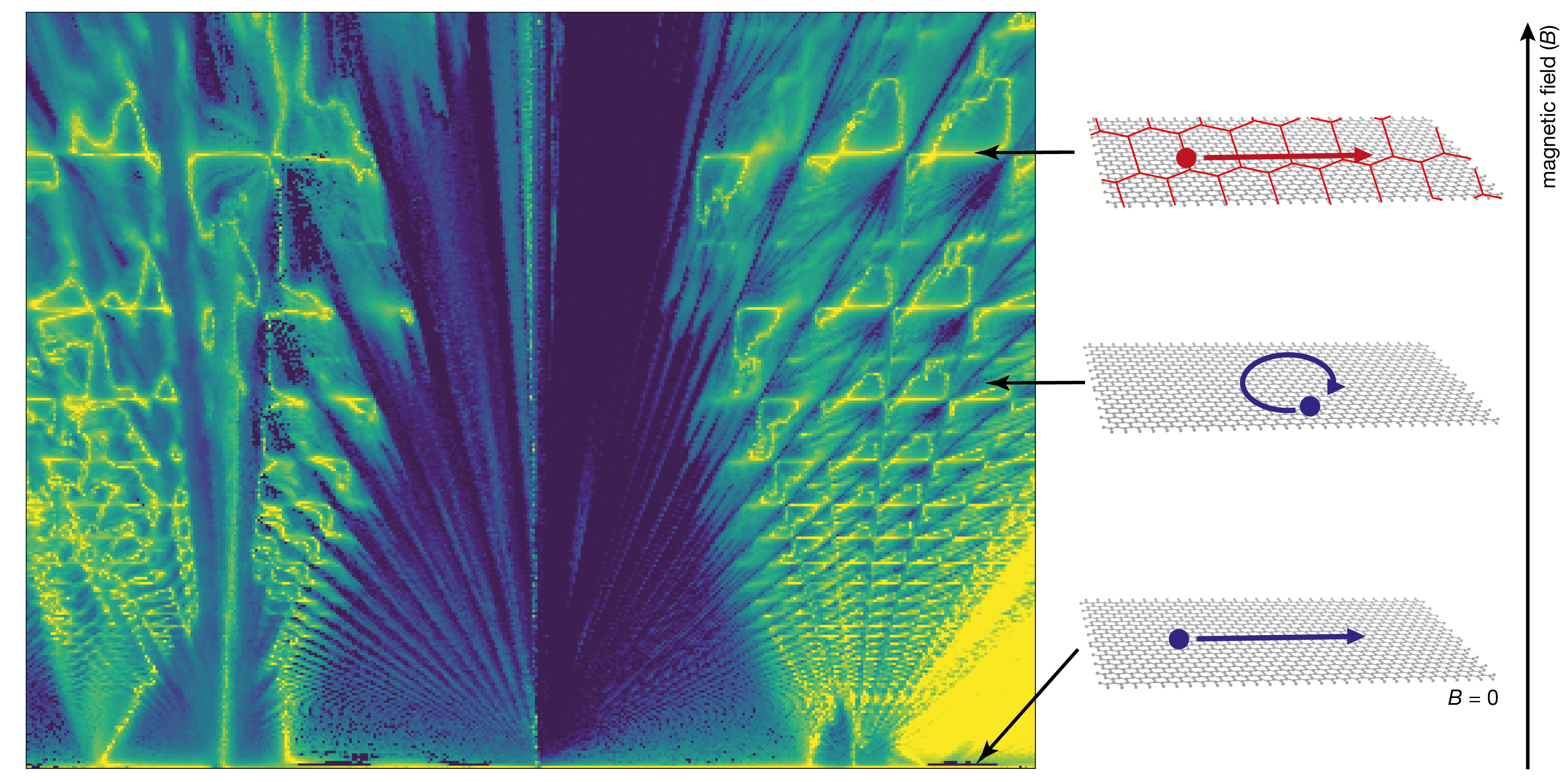
The following image represents different transport regime of quasiparticle in graphene and graphene superlattices: Left: an electron in a graphene sheet propagates in straight trajectories when a current is applied through the material (model of the Dirac fermion); Center: when a magnetic field is applied, perpendicular to the sheet, the electrons have circular orbits; Right: For some exact values of the magnetic field in graphene-hBN lattices, we observe Brown-Zak fermions, that have a straight trajectory despite the high magnetic field. This translates in a lower resistance of the device.

Brown Zak fermion Julien Barrier electron trajectory
BrownZakfermions-01

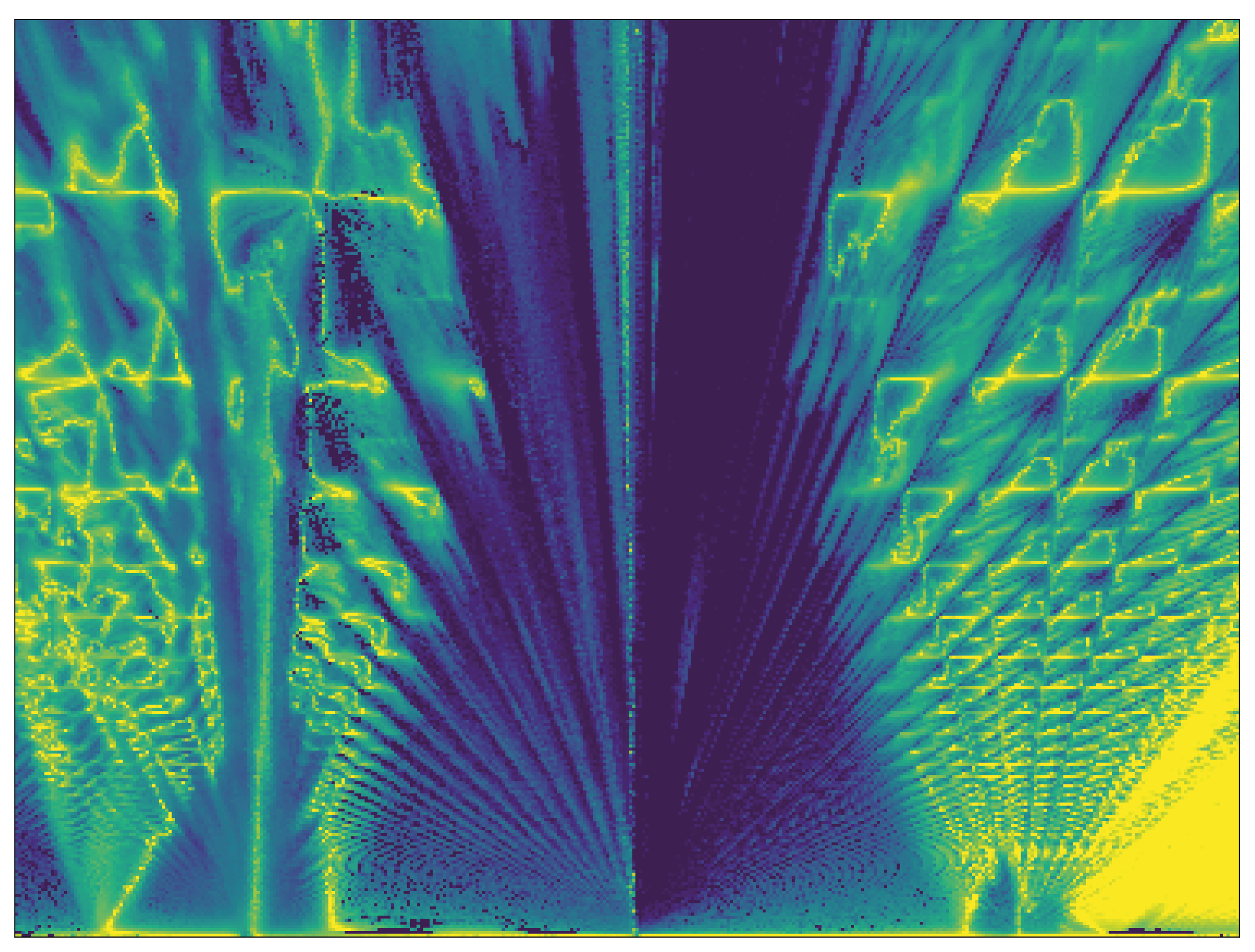
The following picture adds a doping vs magnetic field conductance map and illustrate the paper’s main result: The magnetic field is varied along the vertical axis. Horizontal Yellow streaks show propagation of Brown-Zak fermions, propagating along straight trajectories with high mobility (low resistance), whereas slanted indigo lines show the cyclotron motion around Brown-Zak fermions. The slope of these lines enabled us to get the degeneracy (and find an additional quantum number) of these new quasiparticles.

Brown-Zak fermion Julien Barrier conductance map Landau levels
BrownZakfermions-04

The following image combines the two:

Brown-Zak fermion Julien Barrier trajectory
BrownZakfermions-02
Additional images:

Notes for editors

The paper, Long-range ballistic transport of Brown-Zak fermions in graphene superlattices (doi: 10.1038/s41467-020-19604-0), published in Nature Communications, is available from Friday, 13th November 2020. Before that, a preprint is available at: https://arxiv.org/abs/2006.15040. It should be cited as: J. Barrier et al., Long-range ballistic transport of Brown-Zak fermions in graphene superlattices, Nature Communications, Issue 11. (2020)

More information about graphene is available from www.graphene.manchester.ac. uk.


Anyons in fractional states

Over the past few months, anyons hit the news for two important discoveries. Here I try to give a short introduction to anyons and explain why this is interesting.

About anyons

In condensed matter physics, we usually define quasiparticles, that are not elementary particles, but excitations of collective electrons. This concept has been introduced by Landau and Kapitza to treat helium superfluidity, where they suggested that these excitations could be treated as particles, with a different mass and momentum than the electron itself. Since then, a lot of problems have been treated with quasiparticles, as Brown-Zak fermions we introduced recently, but there are a large range of quasiparticles, with exotic behaviours. Usually, quasiparticles fall into two possible categories: bosons or fermions.

Let’s focus on position, for example (but any quantum number associated with a given quasiparticle would work), and describe a two-particle system with a wavefunction $ \vert \psi (\mathbf{x}_1,\mathbf{x}_2) > $, where $\mathbf{x}_1$ is the position of the first quasiparticle, and $\mathbf{x}_2$ is the position of the second one. If we swap the positions of the two quasiparticles, the resulting state should be $ \vert \psi (\mathbf{x}_2,\mathbf{x}_1) > $.

In the case of bosons - that obey the Bose-Enstein statistics - switching their position doesn’t change the wavefunction: $ \vert \psi (\mathbf{x}_1,\mathbf{x}_2) > = \vert \psi (\mathbf{x}_2,\mathbf{x}_1) > $.

For the case of fermions, that obey the Fermi-Dirac statistics, the Pauli principle forces the wavefunction to be rotated by 180°: $ \vert \psi (\mathbf{x}_1,\mathbf{x}_2) > = - \vert \psi (\mathbf{x}_2,\mathbf{x}_1) > $, i.e. $ \vert \psi (\mathbf{x}_1,\mathbf{x}_2) > = e^{i\pi} \vert \psi (\mathbf{x}_2,\mathbf{x}_1) > $.

Anyons are neither fermions nor bosons. Switching anyons two different places would induce a rotation of some intermediate angle: $ \vert \psi (\mathbf{x}_1,\mathbf{x}_2) > = e^{i\alpha} \vert \psi (\mathbf{x}_2,\mathbf{x}_1) > $. The way to pick up a phase angle that is neither 0 or $\pi$ is to use the Aharonov-Bohm effect to switch particles in a 2D-electron gas. This would induce a phase shift. Importantly, anyons can only exist in 2D systems, as they would violate the standard model otherwise.

Fractional statistics and the evidence of the phase factor

In April, a team at ENS and Sorbonne Université (Paris) have realised anyons and observed their phases. The results have been reported in Science. The authors used a 2D electron gas made with a GaAs/AlGaAs heterostructure, cool it to about 10mK and study it in the presence of a magnetic and electric field. Experimental observation of anyon statistics is challenging as it is based on interferometry, for which theoretical interpretation is difficult.

The interferometer was studied in the fractional quantum hall regime, where quasiparticles have a charge that is 1/3 of the electron charge (Laughlin quasiparticles), for long suspected to be anyons. In this system, chiral conducting channels form along the edges of the device, and tunneling of Laughlin quasiparticles can occur between quantum point contacts (QPC). Ideally, a quasiparticle would be emitted from QPC1 and reach QPC2. It becomes interesting if the quasiparticle reaches a third one: QPC3. As the two anyons reach the QPC from opposite sides. In the case of fermions, they would block eachother rom tunneling through QPC3 because of the Pauli principle. In the case of bosons, correlations between drain currents would appear when the quasiparticles combine together. For abelian anyons, that is different: some correlation is expected, but specific details depend upon the anyon statistics. In a nutchell, the author basically swap particles from a scattering experiment and look at the correlations where particles arrive. This observation of expected anyonic properties provides experimental support to this quasiparticle.

Anyon braiding to build a quantum computer

Much recently, this work has led to further developments. A team at Purdue university interfered anyons in a similar experimental setup and posted it last week on arXiv.org (2006.14115). In their experiment, they create and destroy anyonic states on the bulk of the 2DEG, and produce anyons running on the edges. Between two QPCs, there are two posible paths anyons can undergo. At the end of the journey, an interference pattern would appear. This interference pattern shows the relative amount of rotation between the two paths, with discontinuities that show evidence of the creation and annihilation of anyons in the bulk of the material.

The ability to make anyons appear or disappear raises promises for the building of a topological quantum computer. In fact, pairs of anyons could encode information with the angle phase. The basic interpretation is using the number of circles they made around one another to store data. As the path or perturbations do not alter them, this offers a kind of topological protection to the computation.

References:


Ballistic Brown-Zak fermions: why is that important?

We just submitted the first first-author paper of my PhD, and uploaded on arXiv: “Long-range ballistic transport of Brown-Zak fermions in graphene superlattices”. (arXiv: 2006.15040) In this post, I highlight what we define as Brown-Zak fermions, and why their ballistic transport is important.

Brown-Zak fermions?

There is currently a huge interest in graphene superlattices and artificial stacks that can be obtained by crystallographic alignment of 2D crystals. Until now the community has mostly focused on additional gaps that appear in the Hofstadter-Wannier diagram. We believe that some attention should be directed towards the family of new metallic states that appear there. Particularly, the fermions appearing in rational fractions of the magnetic flux quantum have been eluded as “replica of Dirac fermions” (or described as “third-generation Dirac fermions”). This picture is ambiguous, as we show that these fermions are a different family of quasiparticles, that have a different spectrum as the Dirac fermions, and are described by a new quantum number.

High mobility in 2DEG

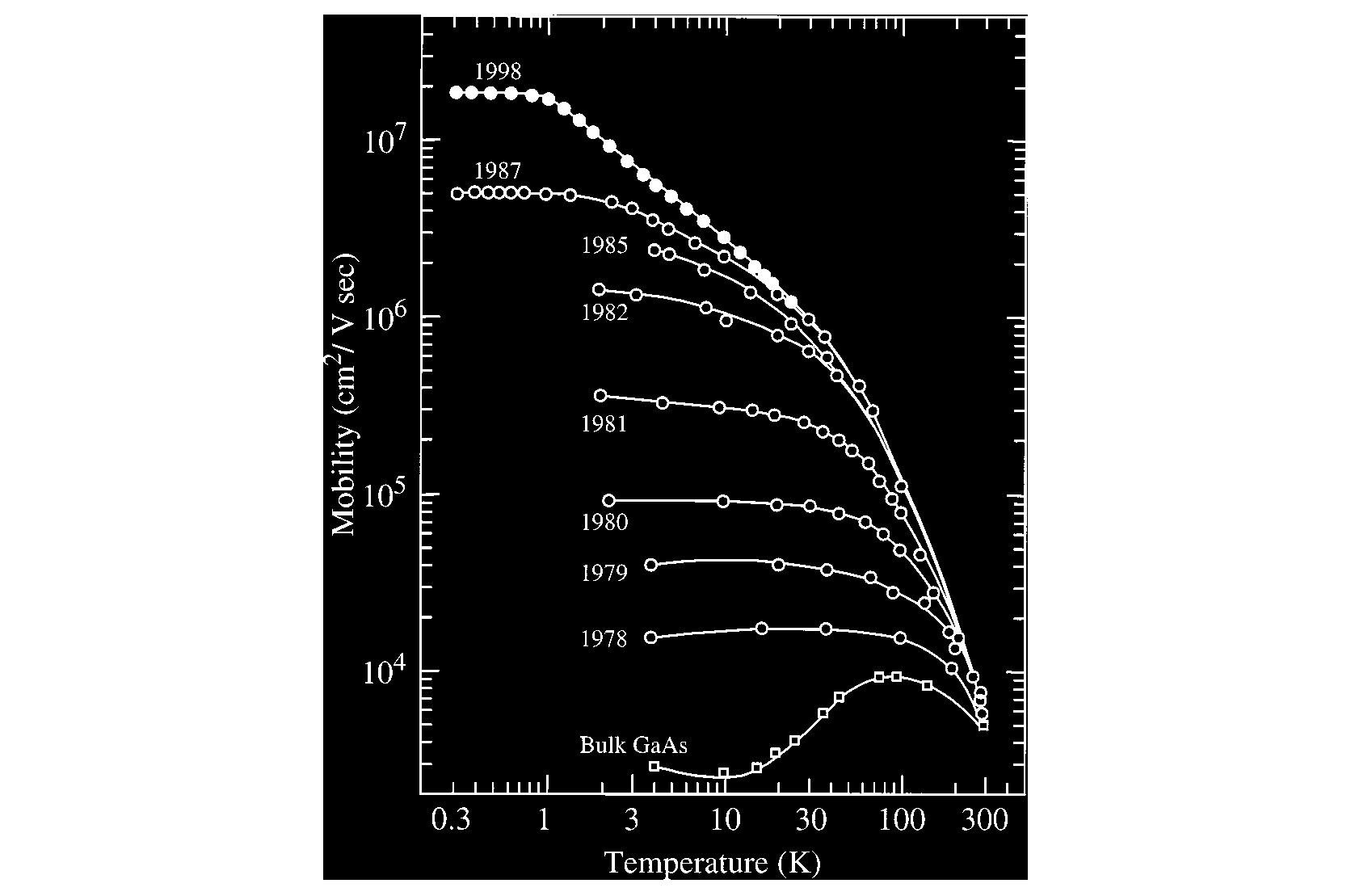
In usual semiconductor 2DEG (e.g. GaAs/AlGaAs), the increase in device quality and induced electronic mobility have resulted in the discovery of a plethora of new effects. For example, the highest mobilities achieved in the early 1980s were about several thousands of cm²/Vs, that allowed the discovery of the integer quantum Hall effect (von Klitzing), and rapid increase allowed further phenomena to be observed, like the odd denominator fractional quantum Hall effect (Tsui, Stormer) and the even-denominator fractional QHE (Willet, Stormer) with mobilities about 10⁶ cm²/Vs. In general, new high-quality 2D electronic experimental systems with high mobility always deliver new physics.

Evolution of the best mobilities (μ) for GaAs/AlGaAs 2DEGs Picture extracted from Horst Stormer's Nobel lecture. At high temperatures, μ is essentially limited by phonon scattering, whereas at low temperature, the only limit is the concentration in impurities and defects.

Ballistic Brown-Zak fermions

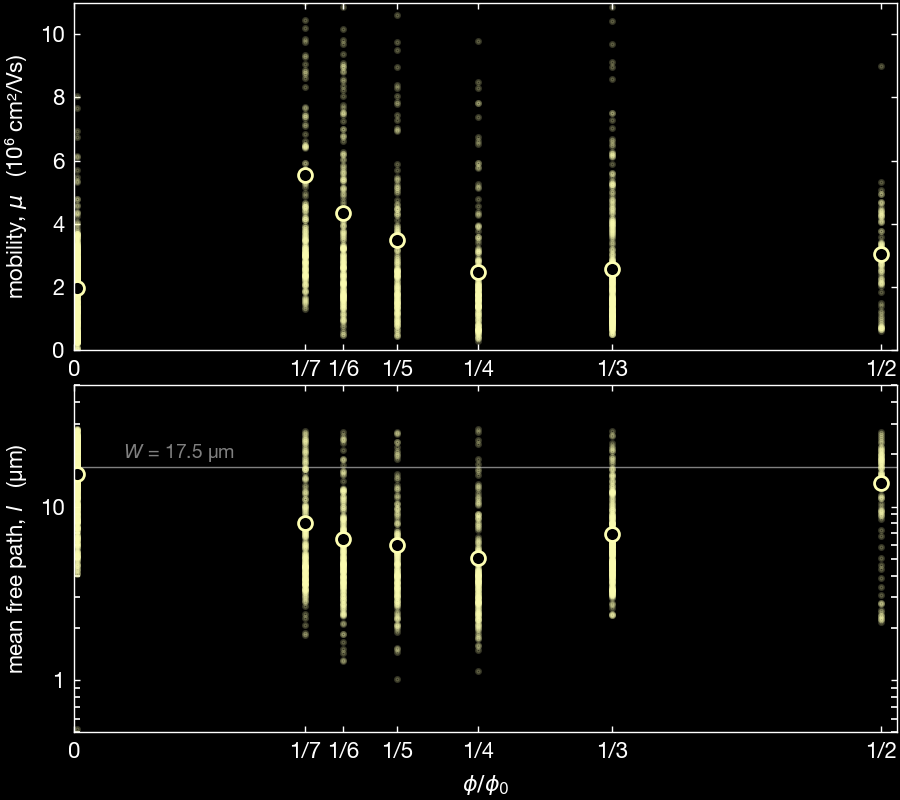
In this paper, we report graphene superlattices of high quality, such as the Brown-Zak fermions exhibit mobilities above 10⁶ cm²/Vs, despite the presence of high magnetic fields, that always force conventional quasiparticles into curved cyclotron trajectories. This is comparable to the best values achieved for Dirac fermions in graphene devices or semiconductor 2DEGs. We demonstrate this in an ambiguous way (negative ballistic transfer experiment), proving that Brown-Zak fermions are Bloch quasiparticles propagating along straight trajectories.

mobilities and mean free path for the family Brown-Zak fermions at fractions of the flux 1/q.

Additionally, the high quality of our superlattices allow us to get new information about the physics of Brown-Zak fermions. Particularly, we show that these quasiparticles are described by an additional quantum number q, that is the mini-valley degeneracy, and depends upon the attached fractions of the flux quantum. This comes over the spin and valley degrees of freedom from the main Dirac spectrum.

Finally, we show that at low temperatures, Brown-Zak fermions are strongly affected by electron-electron interactions. Hence, the classical single-particle Hofstadter model becomes obsolete, as it is too simplistic for the proper description of this family of new quasiparticles. The regime of strong interactions is also found to be full of strange effects, that we can only partially understand at the moment, such as bended fans ore staircase-like features.

In a nutshell, this work shows that Brown-Zak fermions can be seen as a new high-quality experimental platform to study unconventional quasiparticles (high-field but still Bloch-type). This should stimulate further experimental and theoretical work, with our paper showing the way.

References:


What is a Moiré and why is it interesting?

At the end of last year, I receive the prize of the engineer for the Future from the French magazine l’Usine Nouvelle, foreshadowing some of the work I’m carrying out for my thesis.

That was for me the occasion to talk about Moiré lattices. I had planned to give a similar talk for the three minute thesis challenge but because of the covid-19 outbreak, this been cancelled. I now think this is a good occasion to develop this here.

© photo: l'Usine Nouvelle

I started the presentation in December by giving the example of a screen picture: if you take a photography of your screen, you’ll see a wavy pattern, due to the fact the pixels of your phone are misaligned with the pixels of the pictured screen. This is called a moiré, and there are lots of other occurrences of such a pattern in real life.

In condensed matter physics, moiré have skyrocketed over the past two years, as technology now enables to stack incommensurate layers of different 2D materials. For example, combining graphene with hexagonal boron nitride (that has the same honeycomb pattern than graphene, but 2% larger), create another periodicity, with a unit cell on the order of 10nm, that is 100 times larger than the graphene unit cell. We aim at characterising the behaviour of phonons, electrons, excitons and other quasiparticles in this kind of superlattices, and eventually discover new states of matter.

Second-generation Dirac fermions and the Hofsdtater’s butterfly.

The creation of moiré superlattice increases the lattice constant hence reduces the size of the Brillouin zone. For the Dirac spectrum of graphene, it duplicates the structure at higher filling, that we call second-generation Dirac fermions (Yankowitz 2012). In a magnetic field, superlattices made with aligned hBN enabled the observation the fractal Hofstadter’s butterfly spectrum, via the formation of third-generation neutrality points at high magnetic fields. This fractal pattern can notably be described by the Diophantine equation n/n₀ = t 𝚽/𝝓₀ + s, where n/n₀ is the normalised carrier density, with n₀ = 1/Asl, Asl being the superlattice unit cell area, and 𝚽 the magnetic flux per unit cell, 𝝓₀ the magnetic flux quantum, t and s integers. (Ponomarenko 2013, Dean 2013, Hunt 2013, Yu 2014)

Brown-Zak oscillations, or magnetic Bloch states

A more recent examples include the discovery of so-called Brown-Zak oscillations, that are conductivity oscillations occurring at flux fractions 𝚽/𝝓₀ = p/q, where p and q are integers. This is analogous to the Bloch theorem, as whenever the magnetic length has the size of the unit cell, the electronic wavefunction accommodates the periodicity of the lattice and carriers behave as if there were no magnetic field (Beff = 0). In superlattices made of graphene and hBN, the lattice constant of the Moiré is on the order of 10nm, allowing the observation of such states at magnetic fiels on the order of 20T. (Krishna-Kumar 2017 & 2018) One of the project I have been working on recently aims at characterising the new metallic states created in these Brown-Zak oscillations.

Graphene with a twist

For graphene-graphene twisted bilayers, other effects have been reported. The most famous is now the presence of superconducting domes between Mott insulating states, discovered by Cao et al in the MIT group. If the angle between the two graphene layers is much reduced, the size of insulating domains increases and allows the current to flow in 1D channels. Xu, Berdyugin et al, in our group have notably observed an Aharonov-Bohm effect, where carriers are transported through a triangular network and can interfere together, as in the case of the optical Young slits experiment. This leads to oscillations, with a periodicity in magnetic field intensity, that is a function of the angle between the two layers.

These are only a few examples of what becomes possible by stacking two atomically-thin layers together; the future may be even brighter in this field of physics.

References:


Paper explained: Structural origins of light-induced phase segregation in halide perovskites

During Summer 2018, I had a research project at Stanford Synchrotron Radiation Lightsource (SSRL) that was wrapping up my masters degree in chemical physics at ESPCI Paris. I used to work on alloys of halide perovskites, aimed at photovoltaic applications. Some part of the work I did there has been published this week in Matter. I take this opportunity to blog about hybrid perovskites for photovoltaics and how we address one of the current limitations this system faces.

Hybrid halide perovskites for photovoltaics

It is no secret on this blog that the perovskite structure is composed of a BX₆ octahedral framework, in the interstices of which A cations are placed. The band gap of the halide perovskite structure largely relies on the length of the B-X bond, as the valence band is an hybrid of metal (B) p and halide (X) p orbital and the conduction band is an anti-bonding combination of metal s and halide p orbital. Thus, a lengthening of the B-X bond would decrease the orbital overlap, stabilise the valence band, hence reducing the band gap.

representation of the perovskite structure. teal spheres = A site, blue spheres = B site and pink sphere = halides X.

As a result, compositional adjustments of the A and X lattice have shown abilities to distort the perovskite structure and tune the band gap of the material to target specific applications. Particularly, one of the applications that has the potential to reach the market soon is the production of tandem solar cells, that are silicon cells on top of which a perovskite layer is spun. The key requirement for maximising the efficiency of such a cell is to have the perovskite absorbing low photon energies, and the silicon beneath absorbing the high energy photons that would pass through the perovskite layer. To do this, a number of studies have shown that compositions combining formamidinium (FA) and cesium (Cs) on the A site, lead (Pb) on the B site and a mixture of bromine (Br) and iodine (I) on the X site would allow the production of tandem cells with an optimised band gap.

Photo-induced degradation

However, the perovskites of the form (FAyCs1-y) Pb (BrxI1-x)3 are subject to photo-induced phase segregation. In fact, under illumination, thin films made of these alloyed halide perovskites segregate between iodine-rich regions and bromine-enriched domains. Iodine-rich regions have a lower band-gap, that funnels recombination of charge-carriers through energetically-favourable pathways, limiting the voltage of devices, thus reducing the efficiency of solar cells.

Results

However, if the influence of the composition on optical stability is known, the impact of the crystal structure and the changes in morphology had not been isolated from optical instabilities. In this paper, we explored the phase segregation behaviour of perovskites of the form (FAyCs1-y) Pb (BrxI1-x)3, processed as thin films, with controlled morphology.

We used synchrotron x-ray diffraction to map these alloys across the cubic-tetragonal solvus. We coupled these measurements with time-dependent photoluminescence spectroscopy to assess stability under illumination. In the paper, we report that there is an imperfect correlation between the crystallographic phase and the phase segregation behaviour. Notably, we find an island of optical stability onto the phase diagram, that lies in the tetragonal phase. Our conclusion is that the phase is not the sole determinant for optical stability. Then, we proposed several phase segregation mechanisms by eliminating some of the current beliefs with our measurements.

In short, phase segregation is currently limiting mass production of perovskite tandem solar cells. Understanding it and getting over this limit may equip perovskite technology with impressive abilities to target climate change. We proposed here a conceptual framework within which optical stability can be explored. More work is obviously necessary to fully understand both the thermodynamics and kinetics of photo-induced phase segregation, everything of this may guide the design of mixed halide perovskite with optimised band-gaps.

Reference:

Structural origins of light-induced phase segregation in organic-inorganic halide perovskite photovoltaic materials

Rachel E. Beal, Nanna Zhou Hagström, Julien Barrier, Aryeh Gold-Parker Rohit Prasanna, Kevin A. Bush, Donata Passarello, Laura T. Schelhas, Karsten Brüning, Christopher J. Tassone, Hans-Georg Steinrück, Michael D. McGehee, Michael F. Toney, and Ana Flávia Nogueira.
Matter. Volume 02. Issue 01. pages 1-13. January 2020
DOI: 10.1016/j.matt.2019.11.001